A free Mars colony-building, factory automation, incremental strategy and idle tycoon game for Android and web browsers. Players explore a fogged hex map, discover finite resource deposits, construct mines and factories, automate production chains, manage electricity and shared storage, survive Martian dust storms, complete contracts, and compete on global leaderboards.
It is designed for players who enjoy factory and automation games, tycoon games, incremental games, resource-management games and colony simulators. It borrows the production-chain thinking that fans of Factorio, Satisfactory and Mindustry enjoy, but is built around short mobile-friendly sessions, offline progression and persistent long-term progress rather than belt logistics. Structurally it sits closest to idle builders such as Post Apo Tycoon - the same tile-by-tile expansion, offline earnings and leaderboards - with a much deeper factory layer underneath.
Single-player, with online leaderboards and community events
Setting
Near-future Mars colonisation
Released
June 2026, updated continuously
Developer
One independent solo developer
Engine
PixiJS renderer with a deterministic JavaScript simulation
Language
English
Overview
Red Planet Tycoon puts you at the centre of a 256×256 hex map of Mars, almost all of it hidden under fog. You start with 250 Gold, a Command Base, and a build zone three tiles wide. Everything else - every deposit, every biome, every ruin - has to be found by spending Gold to survey outward, one hex at a time.
What grows out of that is an industrial colony. Regolith feeds smelters that make iron. Iron builds solar arrays and storage. Ice becomes clean water, silica becomes glass and silicon, carbon becomes blocks and then steel and fibre. By the late chain you are producing electrical circuits, robotics and servo actuators, and then turning industry toward biology: growth medium, algae basins on meltwater channels, pioneer seedlings and canopy groves.
The arc the game tells is dead rock to living planet. Level 20 is the Atmospheric Processor, the climax of the industrial chapter. Level 30 is the Biosphere Relay, which completes the campaign. Then the Terraform Campaign lets you do it again, harder, on a new or procedurally generated world, keeping permanent progress.
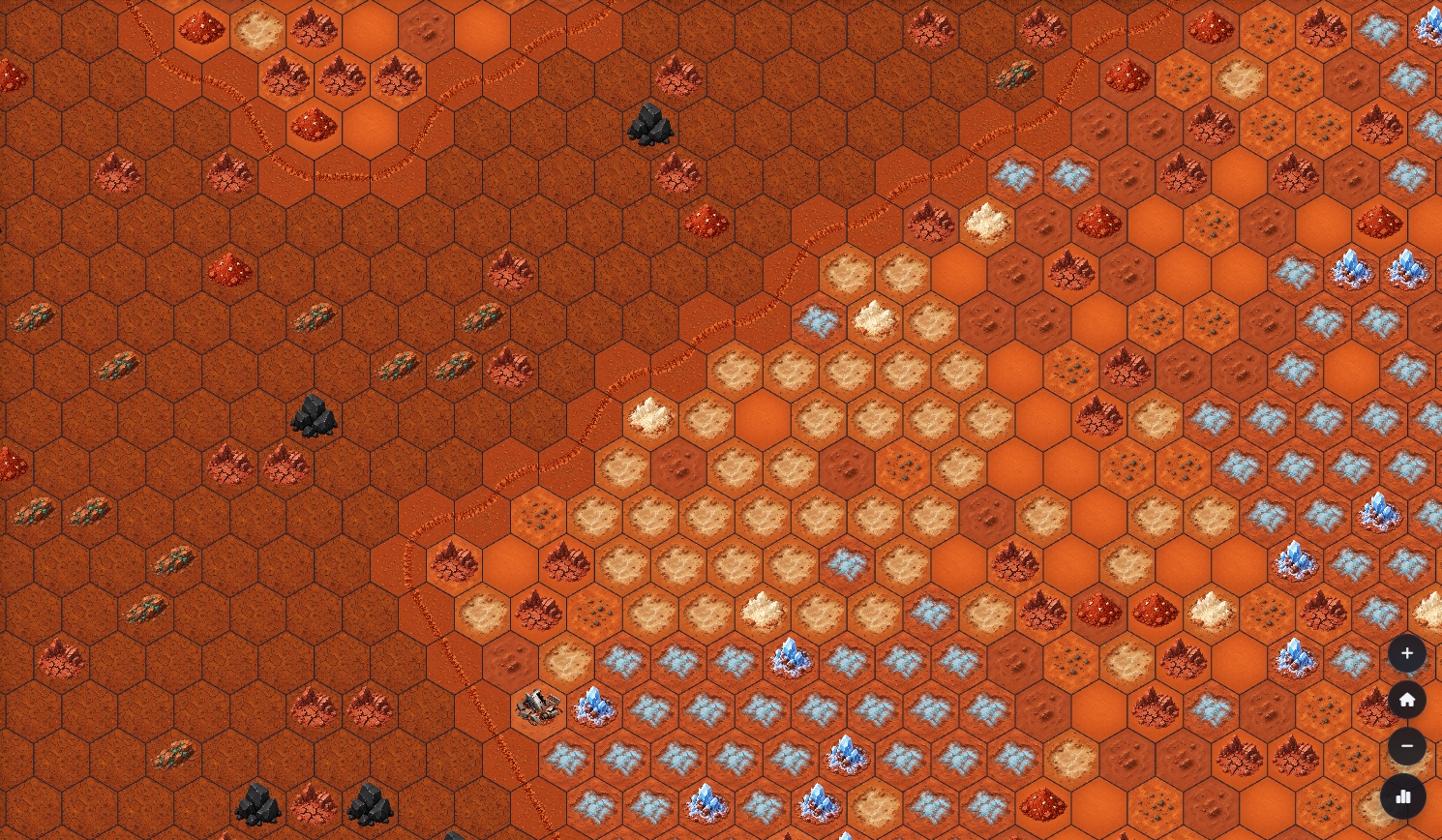
A mid-game colony spanning several biomes, with outposts extending the build zone toward new deposits.
The core loop
Three loops run at different timescales, and they are the whole game.
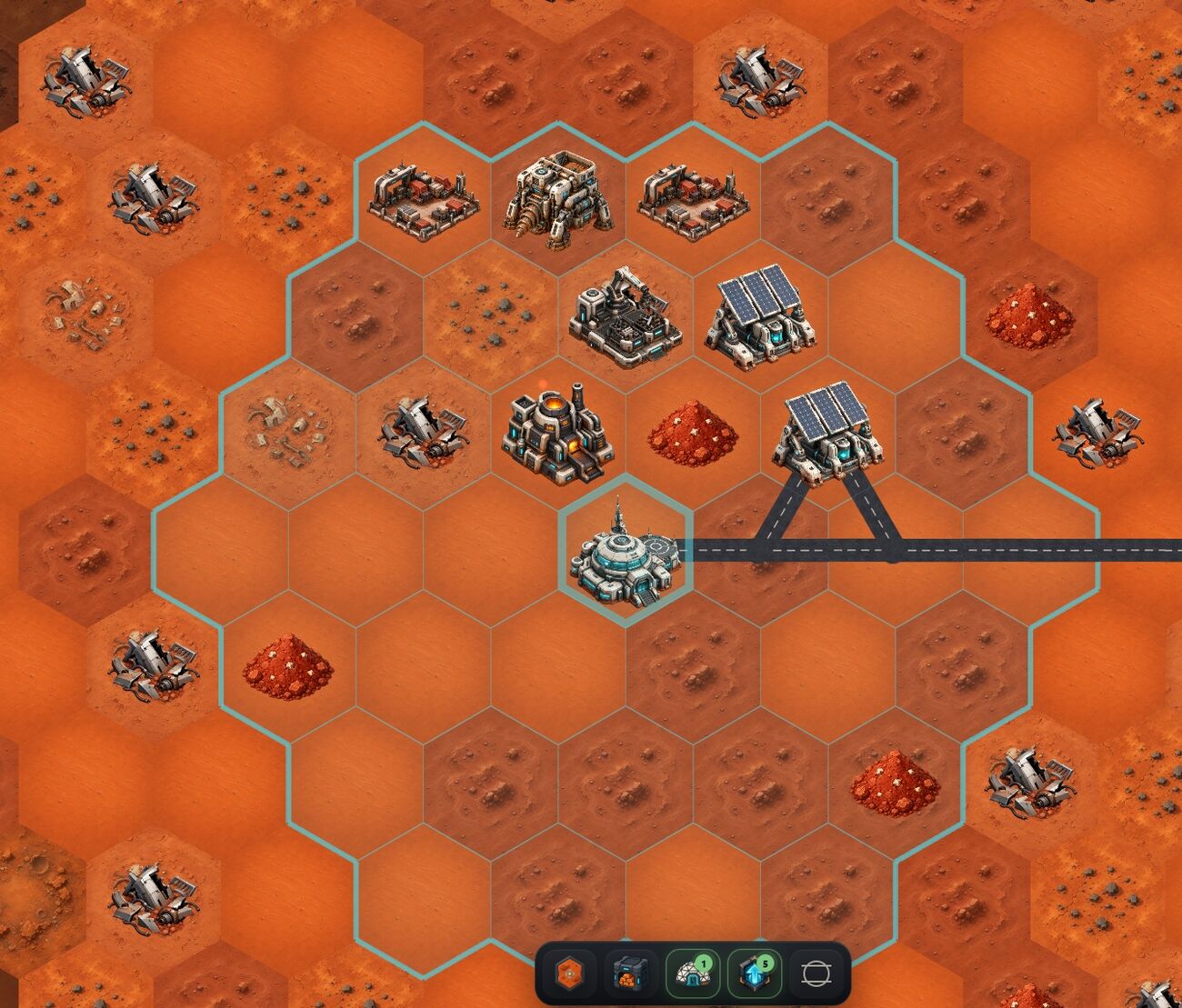
The minute loop is active play: tap fogged tiles to survey, discover terrain and deposits, place extractors and processors inside a build zone, sell surplus at the market, hand in contracts, and spend the Gold on the next survey ring or the next upgrade rank.
The session loop is idle: you come back after a break to an offline report telling you what was produced, what finished building, and what a dust storm destroyed. That report almost always exposes a bottleneck - storage full, power short, a deposit finally exhausted - and clearing it is the session.
The meta loop is prestige. Finish the campaign, replay it with a permanent Terraform Index bonus and an extra perk slot, on a map you can roll from a seed.
Expansion is deliberately the reward, not the chore. Every tap on fog might reveal an ice pocket, a scrap field, an ancient alien ruin that pays Gold forever, or a supply cache worth several times what the survey cost. You are always one tile away from something useful.
The map
The map is not decoration and it is not noise. Twelve terrain types across eight families each carry their own rules: mountain ridges cannot be built on but host wind turbines and carbon; canyon crevices only accept copper extractors; meltwater channels only accept algae basins, and the plains beside them are the only place canopy seeders will take.
Generation is designed to be learnable. Radial bands control what appears at what distance, so the area around your landing site is forgiving and overlay density climbs as you push outward. Directional sectors bias biomes by bearing - ice to the south-west, silica to the north-east, the crater to the south-east, the mountain spine to the east, the wreckage trail to the west - so an experienced player knows roughly which way to go for what they need. A curated core guarantees a fair opening: a starter scrap wreck and a starter regolith deposit are always within a few tiles.
Meltwater channels are the map's most distinctive feature: twenty sparse, traceable, river-like routes of eight to twelve tiles that start well outside the home region. Finding a single blue tile means you can follow it, and following it is what opens the late terraforming chapter.
Terrain determines what can be extracted, what can be built, and what a survey costs.
Industry and automation
There are no conveyor belts, no inserters, no pathfinding and no per-building inventories. Buildings pull from and push to global resource pools organised by tier. That single decision is what makes the game work on a phone: the puzzle becomes what to build, where, and in what ratio, rather than how to route items across a factory floor.
Complexity comes back in three ways. First, ratios: nineteen recipes resolve on a shared ten-second tick, fairly rotated so no single building starves its peers, and a chain that is out of balance stalls visibly. Second, storage: capacity is shared per tier rather than per resource, so a flood of one material can jam production of everything else in its tier. Third, placement: two adjacency systems reward layout.
Neighbor adjacency gives +10% output and input per stack for each completed adjacent copy of the same building, so clustering identical processors matters. Chain adjacency gives +20% output for every distinct input a building actually receives from a connected supplier, directly or relayed through same-tier storage. A well-connected industrial district measurably outperforms the same buildings scattered at random.
Power sits on top of all of it as a global pool with a deliberately harsh step function: full production at 100% coverage, half at 75-99%, a quarter at 50-74%, and nothing below 50%. Being slightly short of power is nearly as expensive as being badly short.
Pressure and risk
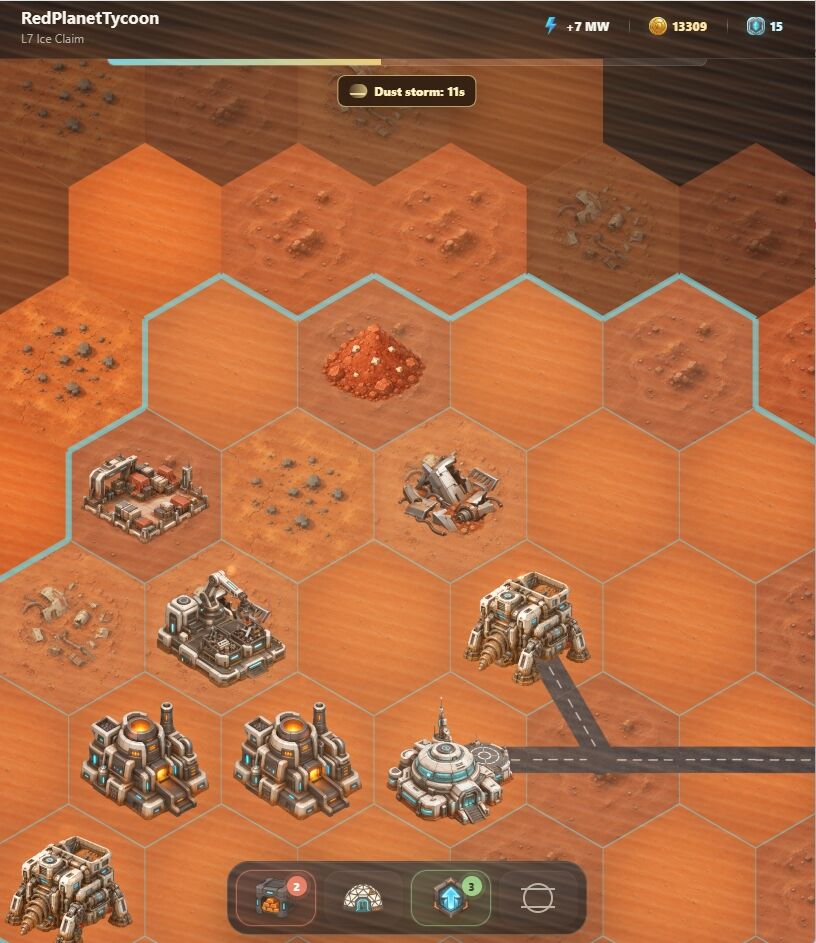
Mars is the antagonist. From level 7 a dust storm arrives at the top of every real-time hour. For twenty seconds it disables solar and wind generation entirely, and it permanently destroys any building standing outside a Command Base or Outpost zone, with no refund.
That single rule turns the map into a running risk calculation, because from the same level you are allowed to build extractors and outposts outside any zone at five times the cost. Reaching a rich deposit early is often worth it - and sometimes it is not, and you watch the away report tell you so. Battery Banks are the counterplay, each supplying 100 MW through a storm, and outposts convert risky ground into safe ground at an exponentially rising price.
Deposit depletion applies the other kind of pressure. A rich regolith tile holds 2,000 units and then it is finished. Nothing about a colony can stay still; it has to keep pushing outward, which pushes it toward exactly the exposed ground the storms punish.
Storms are processed hourly, including while you are away, and losses appear in the offline report.
Economy and competition
Selling is a system rather than a button. Every resource carries its own demand meter measured in Gold value sold, not in units, and there are four price bands paying 100%, 75%, 50% and 25% of base value. Emptying a warehouse in one action drives you straight through the good bands; demand then recovers at a fixed rate per hour. Drip-selling across sessions is simply worth more, and a diversified colony is worth more than one perfect resource.
Contracts arrive at level 8 through Mission Control: five offers, three active at a time, asking for resource deliveries, survey counts, power surpluses or construction targets. They come in small, medium, large and Legendary sizes, pay Gold and reward boxes containing boosters, and refresh hourly. They are generated and signed server-side where the connection allows, which is what keeps global standings honest.
Beyond that: global leaderboards ranked by Terraform Index, then level, then buildings; commander names and country flags; and weekly community events, such as a co-operative contract rally where every player's points pool into one planetary total, or a sprint from a fresh colony to the end of the campaign.
Progression and replay
The campaign is thirty levels, each with an objective, a Gold cost and requirements drawn from surveyed tiles, resource deliveries, buildings constructed, lifetime production, contracts completed or power surplus. Six milestone levels sit alongside the track with larger goals and Core payouts.
Underneath it runs a permanent upgrade tree: 27 upgrades across 112 ranks, bought with Gold or Cores, covering survey strength, extraction and processing output, per-tier storage compression, power generation, construction speed and cost, offline capacity, contract count and payout, market value and adjacency effectiveness.
After level 30, a Terraform Replay resets the colony but keeps your Terraform Index, up to 1,000 Cores, up to 200 Boosters and your equipped perks. Every completed run adds 10 Index up to a cap of 100. Index raises numeric requirements and contract sizes by 1% per point, cuts survey costs and raises market value in 10-point steps, and unlocks one of nine prestige perks per 10 points - from doubling market capacity to halving survey costs to doubling offline capacity.
Each replay can be run on a different world. Four maps exist, unlocked by Index, and every one except the original can be rolled from a deterministic six-digit seed, so a map can be shared as a number.
Content at a glance
Shipped content in the current release.
Buildings
34 - infrastructure, extraction, processing, power, storage, terraforming and market
Resources
19 across four tiers, plus Gold and Cores
Production recipes
19
Terrain types
12, across eight terrain families
Tile overlays
8 - five deposit types, salvage, ancient ruins and blockers
Colony levels
30, with six milestone levels
Permanent upgrades
27 upgrades across 112 ranks
Prestige perks
9, one slot per 10 Terraform Index
Boosters
6
Contracts
8 templates in four sizes, including Legendary
Maps
4, three of which support seeded generation
Map size
256×256 hexes
Quality-of-life systems include a colony-wide building Finder with per-type throttling, live production analytics charts, an in-game assistant that surfaces contextual hints as systems unlock, tutorials, and a detailed away report.
Who it is for
Players who like Factorio-style production chains but want something simpler and more mobile-friendly will find the core pleasure intact and the logistics layer removed. It is especially suited to people looking for browser factory games, Android tycoon games, Mars colony games, incremental strategy games, idle automation games, resource-management games, or anything that can be played properly in short sessions.
It is also a natural next step for players of idle builders such as Post Apo Tycoon. The shape is familiar - rebuild a settlement one tile at a time, keep earning while the game is closed, climb a leaderboard - but the middle of the game is different. Instead of upgrading a building to the next rank, you are balancing nineteen recipes across four resource tiers, budgeting a global power pool, and placing buildings for adjacency bonuses. If the automation part is what you wanted more of, that is the part this game is built around.
It is also worth being clear about who it is not for. There is no combat, no PvP and no direct conflict of any kind. There is no belt or train logistics to optimise. There are no individual colonists with needs, so it is not a people-management sim in the way Surviving Mars or RimWorld are. And the earliest levels are deliberately gentle, so players who want immediate complexity should expect roughly an hour before the chains get interesting.
The FAQ answers the comparison questions in more detail, and the gameplay page documents every system with exact numbers.
Platforms and availability
Red Planet Tycoon is free and playable now.
Web browser:redplanettycoon.com/play - a progressive web app that runs on desktop, tablet and phone with no install and no account required. It can be installed to a home screen or desktop and then runs fullscreen and offline.
iPhone and iPad: play in Safari, or use Share → Add to Home Screen for a fullscreen install. There is no App Store release yet.
CrazyGames: in development.
The ways to play page compares the platforms side by side and walks through installing the browser build as an app on iPhone, Android or desktop.
As of the current release there are no real-money purchases and no third-party advertising networks. The in-game video ads that grant Gold, Cores or Boosters are parody Martian commercials made for the game. Optional Google sign-in enables cloud saves, cross-device play, leaderboards and community events; everything else works without an account.
Development and updates
Red Planet Tycoon is built by a single independent developer and updated roughly every one to two weeks. Every release is documented publicly in the devlog, which has run continuously since the first week of the project and covers balance reasoning, new systems and screenshots of work in progress - including the economy overhaul that introduced finite deposits, the contracts and booster system, the prestige campaign, procedural map generation and the Shattered Highlands map.
No install, no account, no cost. Open the game and the first deposit is a few taps away - or read the full mechanics breakdown first if you would rather know what you are getting into.