
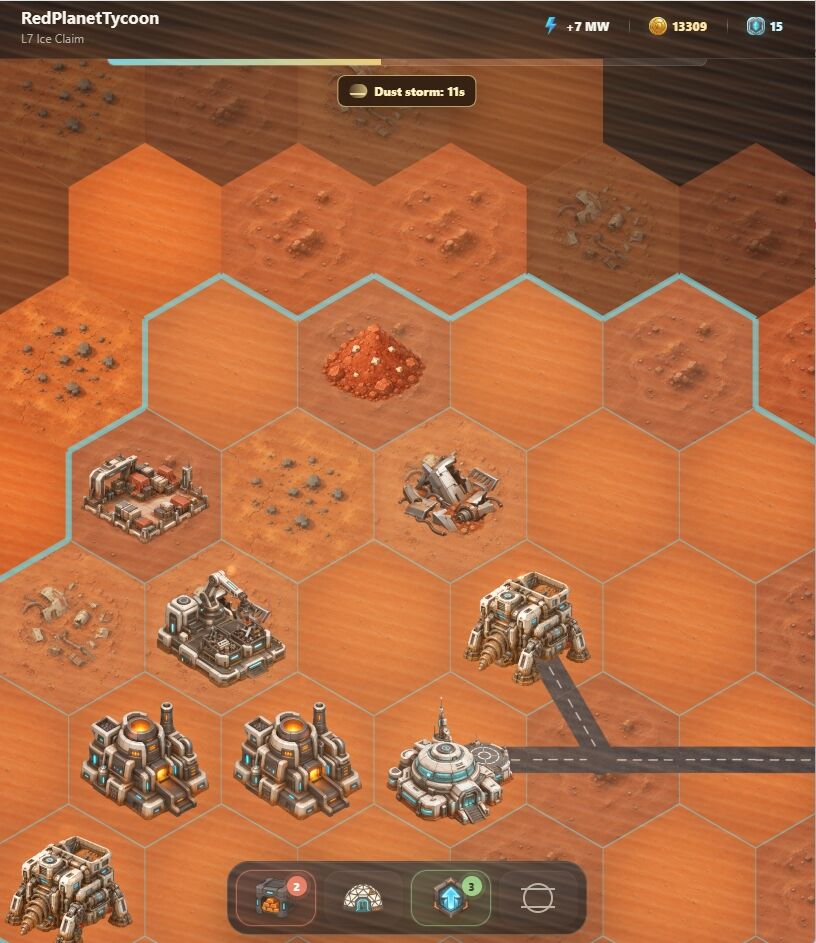
Dust storms changed the map
I added dust storms almost on impulse, partly because real Mars has them and partly because I had just been enjoying Star Rupture. Once I started thinking about it, the mechanic fit Red Planet Tycoon almost too well. Mars should not just sit there waiting to be paved over.
The design problem was outposts. I do not want players to cover the whole map with them. Each outpost is meant to be a real commitment, and the cost and build time rise with every new one. That makes placement matter, but it also leaves a lot of tempting empty space between permanent bases.
Dust storms give that empty space a purpose. You can now build expensive structures outside your outposts, gather from the world for a while, and try to earn back the cost before the next storm wipes those exposed buildings away. It is a small gamble: useful enough to keep you busy, risky enough that it should not become the default answer to every problem.
Expansion should ask better questions
The previous build finally had the main loop in place: claim land, produce resources, complete objectives, upgrade, and push outward. This pass was about making that loop ask more interesting questions. Where should the next outpost go? Which resource pocket is worth a temporary push? When is a short-term operation better than permanent infrastructure?
That is the kind of pressure I want from Mars. Not constant punishment, and not fake drama, but practical tradeoffs. If a storm is coming, maybe the right move is to cash out. Maybe it is to squeeze one more run out of an exposed build and hope the numbers work. I think that could be fun. We will see.
The early game got gentler
I also spent a lot of time balancing the first levels. The game can get harder later. In the beginning, I want players learning the shape of the economy, not wondering why everything is already hostile.
The first five levels now keep a helper window on screen, pointing players toward the next useful action. After that, the same information lives in the missions tab. Level 6 also has a cleaner introduction for roads and outposts, because that is the moment the game starts asking players to think about infrastructure instead of only individual buildings.
More information belongs inside the game
The build, stock, and upgrade interfaces got a pretty broad cleanup. Buildings and items now have more informational windows, and the stock drawer has better source information so you can see where resources come from and what consumes them.
My hope is that players should not need an outside wiki just to understand what a building does or why a resource matters. Some games earn their spreadsheets. This one still needs to be readable on a phone.
It is starting to feel complete
I added more audio, finished a set of missing resource icons, polished level-up and upgrade feedback, and did more of the unglamorous work needed for a PWA release. There is still cleanup left, especially around making sure offline and installable behavior catches all the right assets, but the game is starting to look and sound like a real thing.
The next step is straightforward: get the PWA release path finished and start testing on real phones. That is where a lot of the honest answers live. If the map, controls, onboarding, and pacing survive in someone's hand, the project is in a much better place.