
Defining the MVP
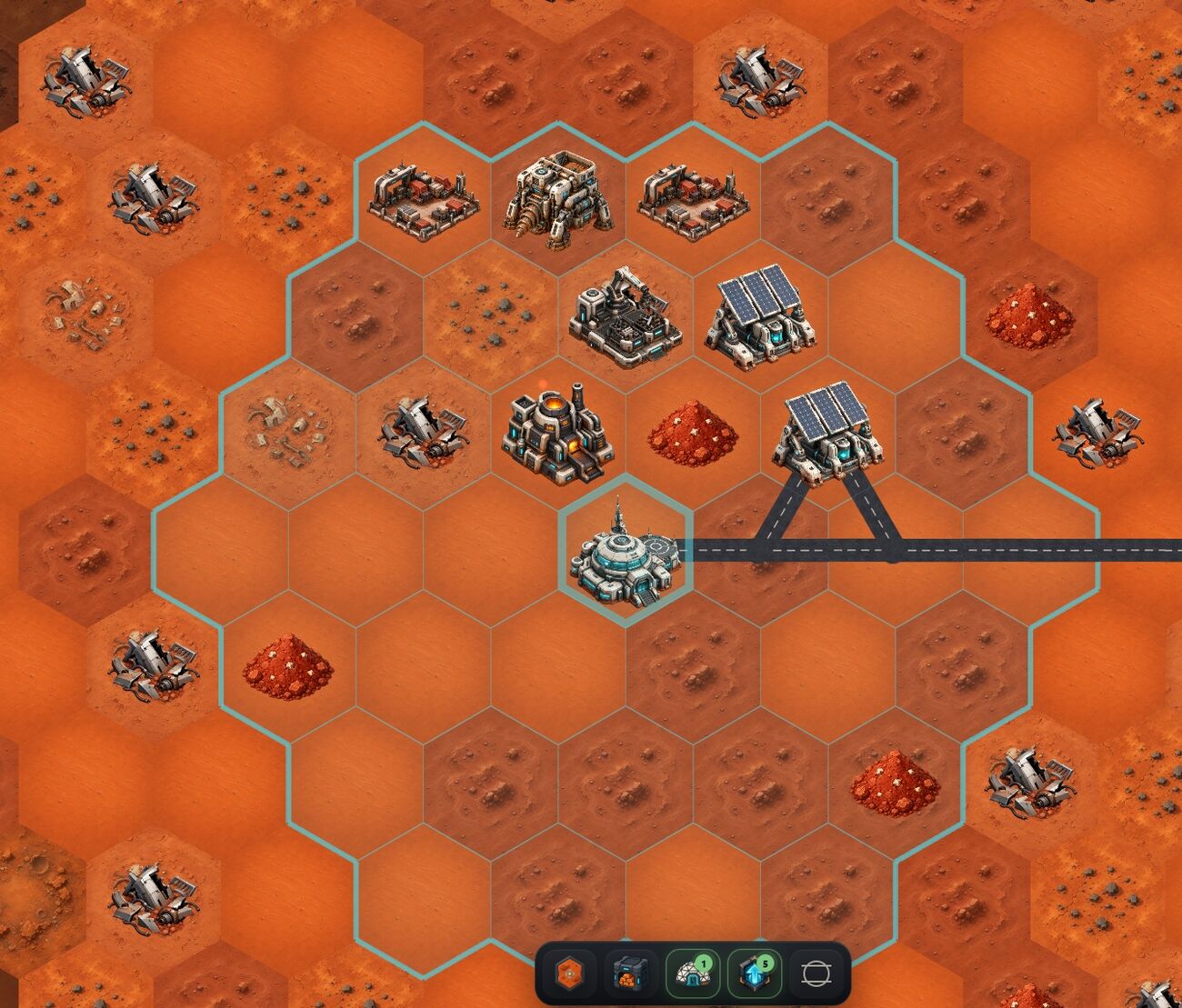
The big job this week was deciding what the MVP actually is. Not the dream version with terraforming, long arcs, and a hundred clever systems. Just the first phase: claim land, build the early colony, produce useful resources, complete objectives, and create enough pressure that the next decision matters.
That sounds obvious until you try to build it. Every feature wants to bring three friends. A simple building needs costs, storage, production timing, unlocks, UI, save data, balance, and a reason to exist. The trick is keeping enough of that complexity to make the game interesting without letting the first playable version turn into a swamp.
The map got smaller, and that made it better
I originally had a bigger MVP map in mind, but I pulled it back to 256x256. That is still plenty of Mars for the first playable version. More importantly, it keeps the work pointed at the real question: does claiming land, reading terrain, and building around resource scarcity feel good?
The map generation is now more deterministic and easier to reason about. That matters for design because the terrain should teach you something. If ice, ore, ridges, and empty ground are just noise, the player is not making interesting choices. If they are readable, each claim starts to feel like a plan.
The loop is alive now
There is a real tick system now, saves, offline progress, construction timers, production, selling, upgrades, and enough UI to poke the colony from a few different angles. It is not polished, but it is playable in the way early systems need to be playable: I can run it, break it, make a note, change a number, and run it again.
I also spent a lot of time on bugs that sound boring but matter a lot: buildings finishing at the wrong time, resources filling too quickly, UI panels showing stale data, and little state problems that only appear after you leave the game open for a while. This is the part of development where the game starts telling you what it refuses to be.
Missions, contracts, and pressure
I added the first pass at missions and contracts. Missions are there to teach the early game without turning into a tutorial wall. Contracts are more interesting to me: they are the pressure valve for the economy. A good contract should make you look at your colony and think, "I can do that, but only if I change the plan."
This is where the balance problems immediately started. Too much pressure and the game feels punishing before it has earned the right. Too little pressure and it becomes a pleasant spreadsheet that happens to have Mars in the background. Finding the middle is probably going to be the key to whether this works.
Where it stands
The game is still early and very unbalanced. I am not going to dress that up. But the important thing is that it has a loop now, and loops are something you can tune. The next stretch is going to be a lot of playing, fixing, cutting, and moving numbers around until the first hour has a decent rhythm.
I want the early game to be easy enough that people can get moving, but not so easy that every choice feels automatic. That line is thin, and I expect to cross it in both directions a lot before it feels right.