
The reason this exists
I really love Mars, space, and science. Not in a casual "space is neat" way, although space is definitely neat. I mean the kind of love where you can lose an evening thinking about habitats, ISRU, launch windows, buried ice, radiation, dust storms, and what it would actually take for humans to build something permanent off Earth.
That is the seed for Red Planet Tycoon. I want more people to spend a little time imagining what human colonization of Mars might look like. Not as a lecture, and not as a perfectly realistic simulator that only a tiny audience can tolerate, but as a game that keeps pointing back to real constraints: power, water, logistics, terrain, distance, and the awful fact that Mars does not care about your plans.
The game should be based on science where that makes the choices better. It should also take shortcuts when the shortcut makes the game readable, fast, and fun. If someone comes in already excited about terraforming and colony engineering, great. If they do not care about any of that yet, they should still be able to enjoy the map, the economy, the upgrades, and the little moment when a messy settlement starts working.
The game I wanted to play
I love tycoon games, strategy games, and exploration games, and I kept wanting to put all of that into one package. This is usually a dangerous instinct. A cleaner product strategy would probably be to pick one lane, sand off the weird edges, and explain it in one sentence.
But I am not starting there. I am trying to build the game I would happily lose days to: a game where expansion matters, the economy has teeth, the terrain is worth reading, and exploring the next stretch of Mars feels like opening a new set of problems. If other people want to join me in that, even better.
Why web, why PixiJS
The game is mobile first. I have a little experience with Godot and a lot of experience with Unity, so both were on the table. But the more I thought about this project, the more it felt like the hard part was going to be UX, iteration speed, and making a large map feel good under your thumb. It is not a game that needs complex 3D graphics to prove itself.
I have also been doing full-stack development for more than 15 years, so the web stack is home turf. I decided to visit an old friend: PixiJS. I spent a day building a proof of concept mostly to answer one question: can I move around a huge hex map smoothly enough for this to be worth doing?
After adding LOD chunks, the answer was yes. The map stayed smooth, the architecture felt understandable, and I could picture the UI sitting on top of it without fighting the engine every step of the way. That was enough to settle the direction.
The editor came first
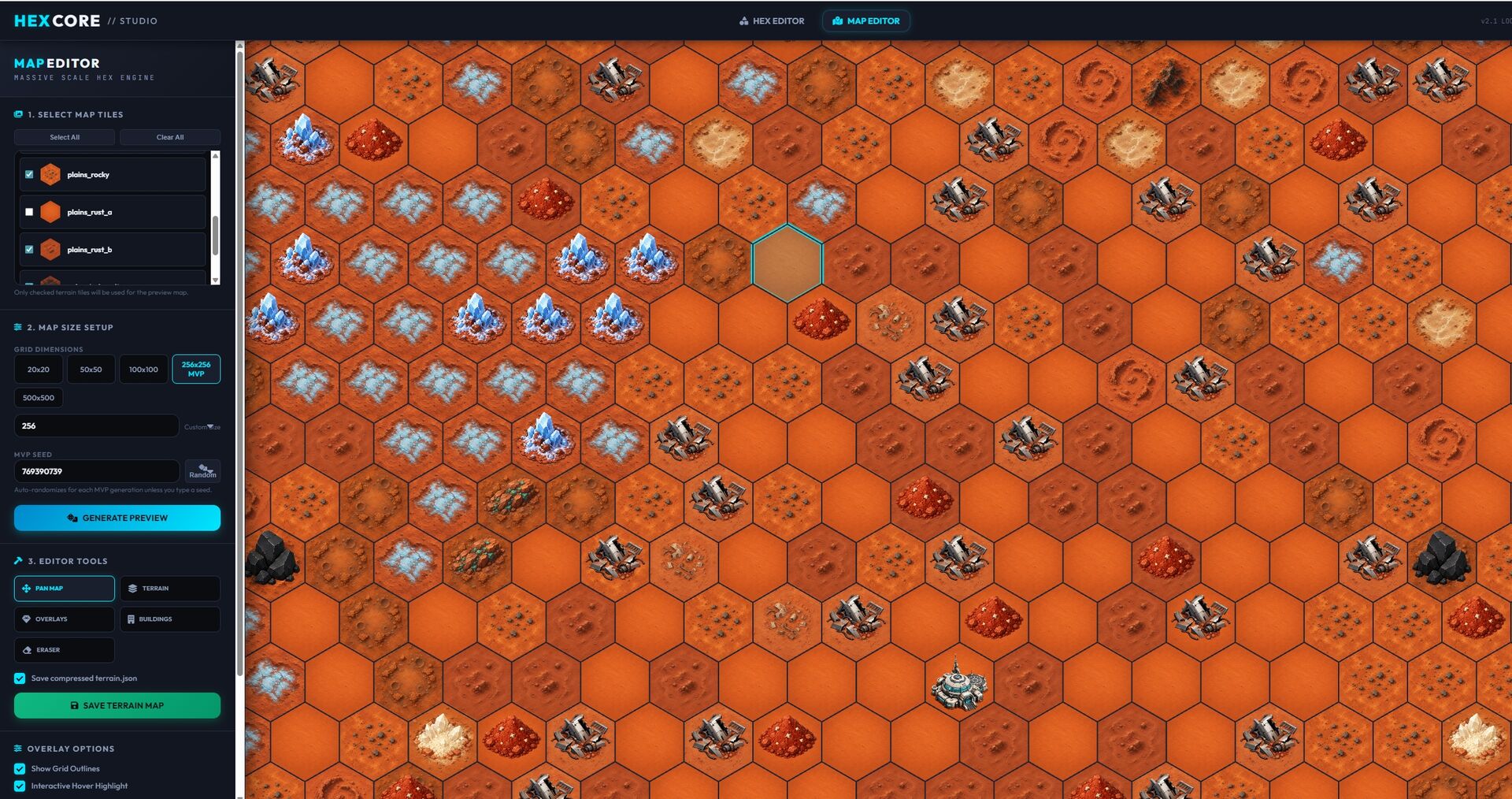
The other big piece this week was a map editor. It lets me generate maps from rules, then go in and manually fix the parts that need a human eye. I already know this tool is going to keep growing alongside the game, because procedural generation is only useful if I can shape the results into something playable.
Honestly, I also want the editor to be fun. If editing terrain, resources, and regions feels like work, I will avoid doing it. If the tool is fast and pleasant, the game will get better maps because I will actually spend time with them.
Next
That wraps the first serious week of development. The next step is the MVP: the phase before terraforming, where the player has to make the first colony work with limited infrastructure and a very unforgiving planet. Hopefully in a few weeks I will have it running on my phone, even if it is rough, just to see whether it feels as exciting in my hand as it does in my head.